Graduate Program
Application deadline is December 15th, 2023.
Test requirements:
GRE Subject Test: GRE Subject Math Test scores are OPTIONAL.
GRE General Test: GRE General Test scores are OPTIONAL.
TOEFL or IELTS: Scores are REQUIRED (the link below contains answers to common questions on these exams including who has to take them).
Standardized Test Questions: Yale Graduate School of Arts & Sciences
Fee waiver: if you wish to apply to waive the application fee (105$) please apply for the waiver here: Application Fees & Fee Waivers | Yale Graduate School of Arts & Sciences. We recommend to do this as early as possible and, at least, several days before the deadline of January 2, 2023. Please note that the department has no control over the waivers.
Program in Applied Mathematics. Note that there is a separate program in Applied Mathematics. You cannot apply for both programs. Follow Welcome | Applied Mathematics Program (yale.edu) for the general information about that program and https://applied.math.yale.edu/graduate-program-0 for the information about admissions, requirements, etc.
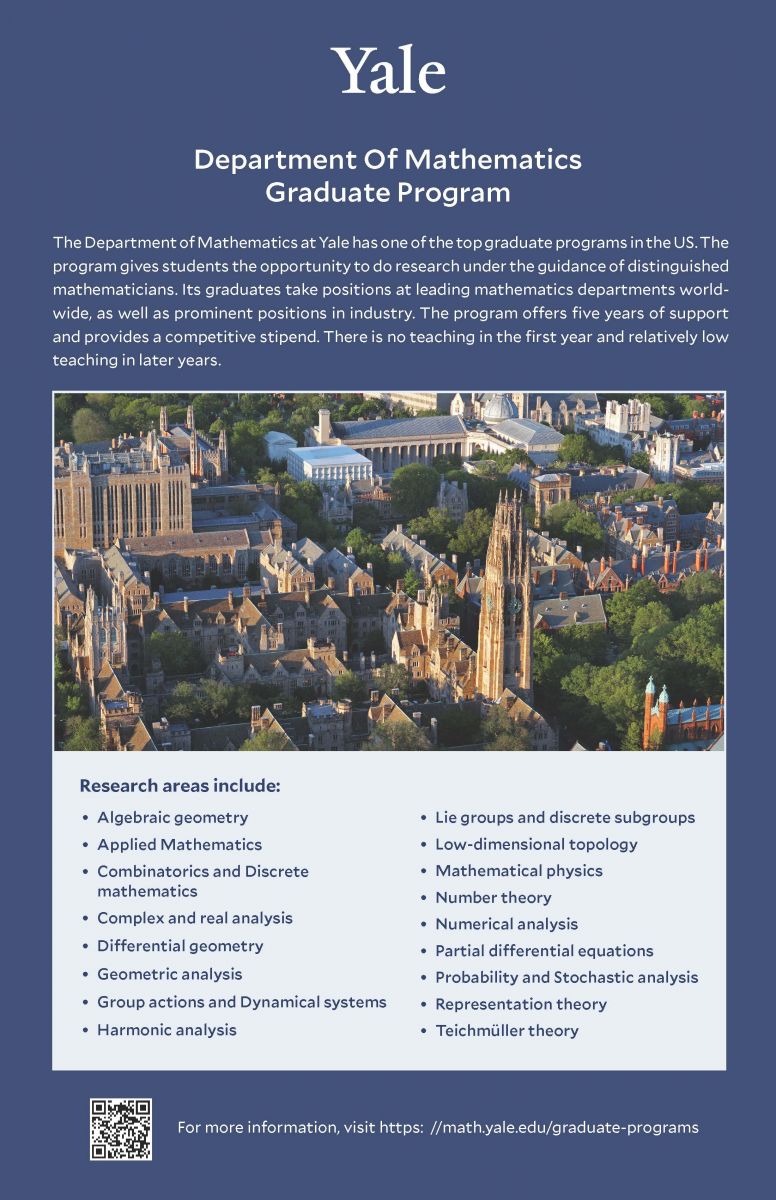
Welcome to the Yale graduate program in Mathematics.
The transition from mathematics student to working mathematician depends on ability, hard work and independence, but also on community. Yale’s graduate program provides an excellent environment for this, and we are proud of the talented students who come here and the leading faculty with whom they learn the profession.
In their first two years, students focus on building their general knowledge and passing the qualifying exams, but are also encouraged to use the time to think about their areas of interest, work together to explore them, and begin making connections with faculty advisors. There are few formal requirements and this flexibility allows students to develop independence, formulating and following their own goals.
Mathematics, while requiring intense individual focus, also thrives on collaborative work. Students form study groups and seminars together, and also benefit from our excellent cohort of Gibbs Assistant Professors and other Postdoctoral Fellows, who are a source of fresh mathematical perspectives and camaraderie.
Research, and the contribution of new ideas and results to the body of mathematical knowledge, naturally form the main focus of the next few years, and typically students complete their PhD by the end of the 5th (sometimes 6th) year. During this time they also get to know the faculty better, and continue building intellectual and personal connections, horizontally across the discipline and through time to our shared intellectual history and tradition.
Teaching is an important component of our profession, and the department provides support and training to graduate students. Teaching assignments proceed from individual coaching to classroom teaching, with careful mentoring provided by our dedicated team of lecturers. The Lang Lunch Seminar, in the second year, provides in-depth training to graduate students before they begin to lecture.
Contacts:
Director of Graduate Studies: Van Vu.
Inquiries concerning the graduate program in mathematics should be sent to Van Vu.
Registrar of Graduate Studies: TBA
Some useful links:
- The mathematics department page in the Graduate School catalog.
- Graduate school homepage for general information.
- Admissions information from the graduate school.
- Mathematics Graduate Program Advising Guidelines